Sunday, July 6, 2014

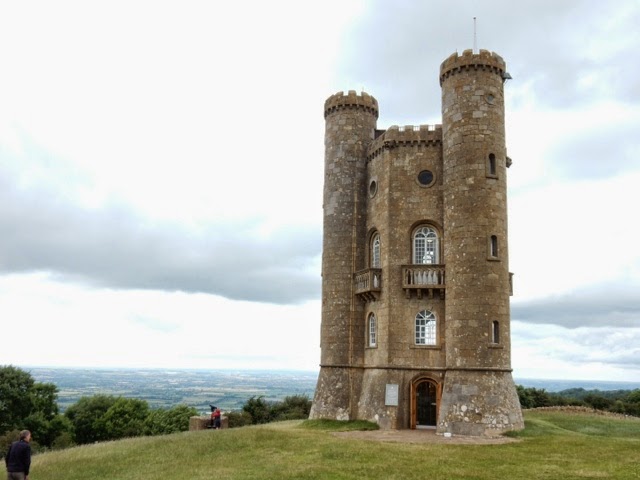
Broadway Tower

Broadway Tower

On our way out of Broadway on Friday, we finally made it up to Broadway Tower. I had wanted to walk up to it every day since we arrived, but everyone always had better ideas (or it was about to rain).

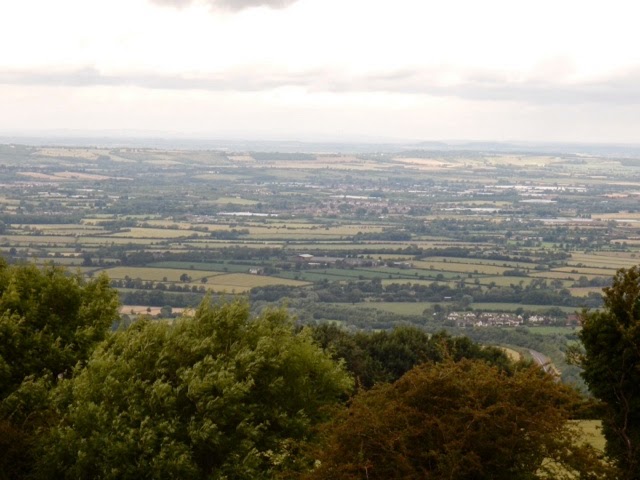
Broadway Tower is a folly, meaning it was never a real defensive tower. However, the views from the top are remarkable. They say on a clear day, you can see into Wales. I don’t know if it was considered a “clear day” when I was there, and I wouldn’t recognize the Welsh border in the distance, anyway, but here is the view from the top of the hill:
View from Broadway Tower

If you’re in Broadway, I recommend you walk to the tower. I didn’t, but I wish I had. Do it for the walk and the view, though, not so much for the tower at the top. The view and the tower look nice, but the tower being a folly, you can better spend your time at real historical sites. If you don’t think you can persuade your kids to hike up a mountain, you can drive by it on your way to Snowshill Manor.

Blenheim Palace

Blenheim Palace

In the early 1700’s, France and the Holy Roman Empire disagreed over who would succeed Charles II to the Spanish throne. England did not have a suitable candidate of its own, but it still felt obliged to get involved in The War of Spanish Succession. I suppose if you can’t be king, you may as well play kingmaker. England fought for the Habsburg candidate — his name isn’t relevant, because he never does become king. A few years into the war, alliance forces under the command of the Duke of Marlborough defeated the French at Blenheim. It was not a conclusive victory — the war itself would drag on another 10 years, and in the end, the French candidate would be secure as King Philip V of Spain — but it was a good enough job Marlborough had done that day that Queen Anne awarded him crown lands at Woodstock and enough money to build a magnificent palace on it. Thus was born Blenheim Palace, the only nonroyal palace in the realm.

The Duke of Marlborough still lives at Blenheim, so Blenheim Palace is the nicest residence I have ever been to. It is truly magnificent and should be included on your itinerary. The grounds themselves, carved out, crafted, and landscaped by Capability Brown are considered to have some of the finest views in all of Europe. What used to be just a little stream running through the grounds was dammed up and used to produce magnificent ponds and islands.

A view of the Blenheim landscape

And I think everybody should reward themselves with a 134-ft high column every time you do a good job at work. Marlborough’s “Column of Victory”:

Column of Victory

The exterior of the palace is nice. It is made of that sandstone that so much around these parts (including the village of Broadway) is made of, which gives it an orange hue. Having recently power washed my driveway at home, however, I really think the current duke would be thrilled to get a power washer. I’m sure he’s never done a bit of work in his life, but I think the thrill he would get by seeing some of his walls or statues get clean would entice him to power wash the entire exterior of the palace. Himself.

Statues lining the roof of Blenheim:
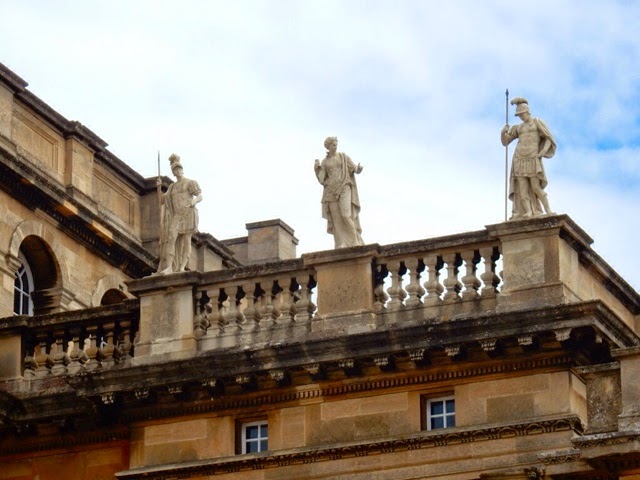
Statues lining the roof of Blenheim

While the exterior has its statues and columns and details that make it seem beautiful and expensive, the interior is really something else. Ancient and modern statues and busts of Roman emperors and gods, paintings of the family, a whole series of room-sized tapestries illustrating the victory at Blenheim, a dining room table and solid silver centerpiece that weighs over 100 pounds and which Consuelo Vanderbilt liked to call her cache mari because it conveniently hid her detested husband (the 9th Duke of Marlborough) from view across the table. Their library has a larger than life statue of Queen Anne at one end and a set of organ pipes at the other that would make any church jealous. Oh, and their private little chapel? Let me just say they must be a very religious family, for they spared no expense on that.

Larger than life Queen Anne statue in the library:
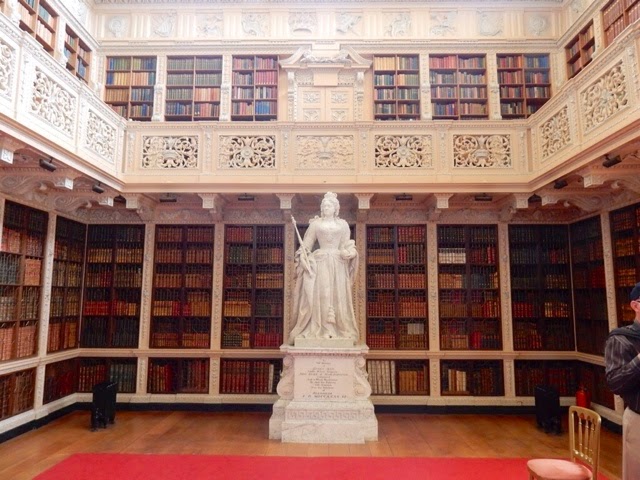
Larger than life Queen Anne statue in the library

A view down the library to the organ at the other end:

Just a little organ:

The family chapel, in case you didn’t make it up in time for church:

Blenheim Palace is a full day’s outing for the family. The kids will grow bored with the guided tour of the inside, but we still did it, since the parents wanted to learn more. There was an exhibition on Winston Churchill, who was born in the palace, which thoroughly bored the kids, but we told them if they were good, we would spend some time in the “Pleasure Garden” at the end of our stay. If you had multiple days, you could spend one of them roaming around the vast estate, but you’ll probably be more short of time than money, so there is a golf cart tour around estate for £2.50 per person. I’m on the fence as to whether it was worth it; it did save us time and allow us to take in more of the beautiful estate, but the walk also would have been nice.

At the end, when your kids have let you walk around the palace, take them to the “Pleasure Gardens” to run around. You can walk it, or there is a train that can take you there every half hour for 50p per person. We walked there and took the train back. The walk is nothing special, so if you time it right, use the train for 50p. At the “Pleasure Garden,” there is a really good hedge maze which the kids will run in and find their way through much faster than you. There is a bar, so adults can walk the maze with a glass of chardonnay in their hands. There are big chess and checkers boards, and playground equipment, along with a pretty decent playground set behind the “Pleasure Gardens.” While we were there, Wimbledon was going on, so the Palace had set up a big screen outside so guests could keep up with the tournament.

All in all, I recommend Blenheim Palace for traveling families. It may not be the most kid-friendly destination, but the kids will appreciate some of it, and they will enjoy the “Pleasure Gardens.”
Saturday, July 5, 2014

Driving in England 2

I lost a bet with my wife. A few days ago, she told me the Tour de France was going on in Yorkshire while we are there. I told her that was not possible, since the Tour de France took place in France. So now I owe her a bottle of wine.

Yes, the Tour de France does start in Yorkshire this year, so on Friday, the day before the race started, we were stuck in traffic with a million other people. It was extremely slow going, and we arrived in Richmond a good 3 hours later than we should have.

It’s been years since I’ve navigated stop-and-go traffic in a stick-shift, and that clutch sure does get a lot of action. However, my main complaint about British drivers in heavy traffic is that they are immature. As a foreigner in England, it is to be expected that once or twice you’ll find yourself in the wrong lane. When we did, if I signaled and tried to merge into the lane I needed, the car behind me already in that lane would accelerate to prevent me from merging. I always think this is funny, because (1) on a road with a million other cars, one car is not going to significantly change your arrival time, and (2) because when this happens the logical next step is to move forward one car and try to merge in front of it, so the car that refused to let you in is still no better off than he would have been if he’d just let me in.

Anyway, some people said the M1 motorway is typically bad on a Friday afternoon, so adding in the Tour de France traffic just made it horrendous. My recommendation, if you’re driving up to The North, don’t do it on a Friday, and definitely don’t do it on the Friday before the start of the Tour de France if that start is happening in Yorkshire.

Thursday, July 3, 2014

Melton Mowbray county fair

Jousting

On Sunday, we visited Melton Mowbray for their annual county fair. Melton Mowbray is smack-dab in the middle of England, just under 2 hours drive from our base in Broadway. When we finally got there, it had just started to rain, and the thermometer was down around 15˚C/60˚F. I was in shorts and short sleeves. As we ate our lunch in the car, we watched more intrepid Englishmen and women get out of their cars, bundle up, and off to the fair.

Well, we decided that, in this weather, we weren’t going to enjoy the fair, so we decided to head off and see if there was anything else worth seeing in the area. As we were headed out of town, one of us needed to go to the bathroom, so we stopped in at a park with public facilities. After we parked, we discovered that we had found the one free parking spot near the county fair, so we thought we really ought to pay it a visit, seeing as it is right here.

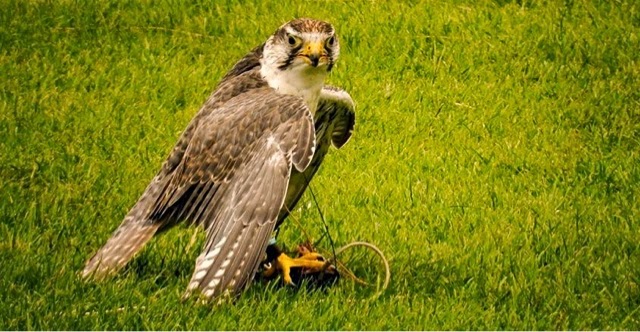
Admission was £10 for the whole family, and just as we arrived, a show of falconry was on display. Looking skyward, we could watch the falcon dive and swoop, and eventually come to land next to its trainer. I remembered a bit of trivia about the falcon being the fastest animal in the world, and my son was suddenly able to fill in the details about it being the Peregrine Falcon.

Falcon pic

There were some bagpipers and then we joined in some Victorian dancing with a Victorian dance troupe. A welshman also demonstrated his champion sheepdogs, herding ducks around the field. Walking the stalls, we got some free samples of locally made liquors, and ended up liking a brandy so much, we bought a small bottle for enjoyment later. We also met and talked to members of the Knights of Nottingham, a group of riders who would be putting on a jousting show at 4.

Trying out Victorian dance:
Victorian Dance

There was a beautiful church in Melton Mowbray, which first caught our attention when we looked skyward for the falcon during the falconry display; it had a beautiful bell tower (as so many churches here do). So while waiting until 4 for the jousting, we walked over to it to check it out. The church was very welcoming, offering us drinks and a tour, which we accepted. As a visitor to England, you don’t have to go to Melton Mowbray to see their church, but you should go to one or two old churches as you travel around England, and St. Mary’s in Melton Mowbray is one of the best. St. Mary’s dates to prior to the Norman conquest, but the current building was built in 1170 and includes many tombs and crypts, including that of a crusader. Although not a cathedral, it was built in the cathedral style, one of only 5 parish churches in England to do so. The church member who showed us around explained that the church had applied in recent years to be elevated to cathedral status, but its application was denied.

St. Marys parish church, Melton Mowbray

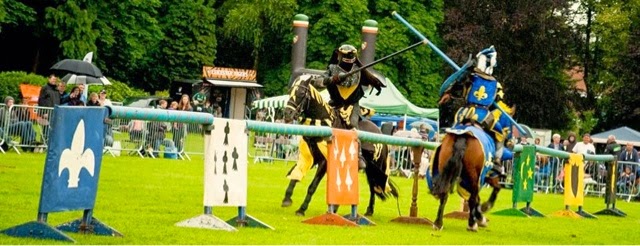
Finally at 4, the kids were treated to a jousting display by the Knights of Nottingham. The Knights put on a show, including sword and axe fighting, with a comedic element, but certainly the best part was the mounted fighters. I ride just once or twice a year, so seeing expert riders ride around prone “casualties” on the battlefield without stepping on them was impressive. Their display of horsemanship against unmounted fighters was also impressive, but of course, we all wanted to see the knights make jousting passes with their lances, which they obliged. It was all acting, of course, but it was still great fun!

Jousting Knights of Nottingham

All in all, I am very glad we made the fair, because the whole family had a great time. And Melinda enjoyed the brandy we had bought that same evening back in our cottage in Broadway.

Wednesday, July 2, 2014

Coughton Court & Charlecote Park

Coughton Court

We had planned to visit Blenheim Palace today, but discovered that it is 20% cheaper to purchase the tickets in advance, so purchased the tickets for tomorrow and headed off to some nearby manors.

Our first stop was Coughton (pronounced coat-on) Court, home to the Throckmorton family for hundreds of years.

“The Uglies,” two ladies of the Throckmorton family:
Uglies

The Throckmorton family is a proud unreformed Catholic family that got involved in all the intrigues of the 16th and 17th centuries. Given their penchant for choosing the wrong side, it is surprising that they not only held onto Coughton through the turmoil, but even got themselves elevated to a baronetcy.

  • The Throckmortons opposed the reformation in England, and allowed their family home to be used for secret Catholic masses at a time when doing so was a capital crime. Their house contained a “priest hole” to hide a priest when anti-Catholic mobs came a-calling, and they even secured Catholic treasures such as a cope embroidered by Katherine of Aragon and the chemise allegedly worn by Mary Queen of Scots when she was executed (probably a fake, since all of Mary’s possessions were burned to avoid precisely this).
  • The Throckmortons, along with their friends and relatives, are associated with the Gunpowder Plot of 1605 to assassinate King James I. This was not a good plot to be involved in, but the Throckmortons avoided being hung, drawn, and quartered like the core conspirators.
  • During the English Revolution of the mid–17th century, the Throckmorton’s joined the royalist cause against the Protestant parliamentarians. As you know, this was also the wrong side.
  • And even after the Glorious Revolution of 1688, The Throckmortons continued to support the Jacobite pretenders.

The Throckmorton seat, Coughton Court, is interesting for its history, but not the thrill of a lifetime, so if you miss it, it is not the end of the world. The estate has some pretty gardens and lawns, and Paul and I went out to toss around a football, for which we were rebuked, since picnicking and games are not permitted on the lawns.

After lunch at Coughton Court, we went on to Charlecote Park, another manor house. Unfortunately, the house itself was closed (closed on Wednesdays), and the Royal Shakespeare Company was using the closure to do some filming of its own. However, although the house was off-limits, the grounds were not. I played some croquet with my children on a nice croquet lawn, and we saw a herd of deer up close.

Deer

One of the highlights of the afternoon was enjoying a few games that had been laid out on one of the lawns. We played a Jenga-like game on the lawn (bigger pieces), threw a frisbee they provided, played Connect–4 in a big wooden frame, and my wife and son bowled and played checkers. It was a restful hour or so, enjoying the beautiful weather and scenery.

Like Coughton, Charlecote was an enjoyable visit, but not mandatory.

Hailes Abbey

Hailes Abbey

In addition to allowing the king to marry Anne Boleyn, Henry VIII’s conversion to Protestantism enabled him to close the monasteries and steal their riches. On Christmas Eve 1539, his commissioners arrived at Hailes Abbey near Winchcombe, turned out the Cistercian monks, and seized all the gold and wealth of the abbey. After they left, other vultures showed up to loot anything the commissioners had missed, and so, for 500 years, Hailes Abbey, which had once housed a vial of Jesus’s blood (burned by Henry’s agents), fell into disrepair and was forgotten.

We visited the ruins of Hailes Abbey after our visit to the Roman villa in Chedworth. The road from Chedworth to Hailes is almost entirely one-lane narrow country roads, up and down the hills of the Cotswolds. It was a challenge to find, and we had to stop at a farm to ask for directions, since it was really hidden away. In fact, if we had approached it from any direction other than Chedworth, it would have been much easier to find, as it wasn’t too far off the beaten path.

Very little of Hailes Abbey remains, but there is an outstanding audio tour available that teaches you all about the abbey and leads you around the foundations. Like other National Trust sites, parking and admission is free to members. The audio tour costs £1, which gives you an audio guide for each member of the family (as opposed to one to share), which means your kids can go at their own pace. This proves helpful, as our 8 year-old raced through and then enjoyed running around the ruins while we old fogeys stepped through the entire tour.

At the museum shop, the docent had samples of some local wine for sale, which we sampled and then bought a bottle.

While not a must-see on your English itinerary, it was good enough that I would recommend it if you’re in the area. You can do the whole abbey in about an hour.

Tuesday, July 1, 2014

Chedworth Roman villa

North wing Columns

In 1864, a gamekeeper stumbled across some mosaic tiles in the forest. It turned out to be the remains of one of the largest roman villas in Britain.

Mosaic floor inside the villa:
Mosaic floor

I studied ancient and medieval history in college. For me, one of the most interesting periods in history is the Dark Ages, from about 400 to 1000 AD. What is so fascinating to me is how far society regressed, and how little is known about the period. How did civilization forget?

One of the most interesting discontinuities in this period is what happened in Britain. Rome had occupied Britain for some 400 years, converting much of what is modern-day England to Christianity in the process. Unlike mainland Europe — France, Spain, and Italy — which retained many Roman characteristics after their conquest by Germans, Britain un-Romanized almost completely with the German invasions from the east. So complete was the de-Romanization, that most people — not scholars of English history — when they think of English history, skip straight from the Celts and druids of old to the Normans of the high Middle Ages. If they’re aware of the Roman occupation at all, it is considered a brief, insignificant event.

But 400 years and the Christianization of the Britain is neither brief nor insignificant.

Chi-rho monogram found etched at the nymphaeum, indicating that the residents of the villa were Christian:
Chi-Rho monogram

We visited the Chedworth Roman villa today, and I really liked it. Although not much of it remains, it has been excavated, and enough of the site is visible to give a very good idea of the size and shape of the villa. It must have been beautiful, and while we don’t know who lived in it for the 300 years it was occupied, its occupants must have been rich, and probably powerful. The villa had elaborate mosaics, underfloor heating, and two exquisite bath systems.

We had been planning to visit Bath this trip, to see the Roman ruins there, but Chedworth has scratched the Roman “itch” in us that we no longer feel like we have to. If we had unlimited time, certainly we would visit Bath, but when traveling with children, we can’t just go and look at ruins; children are not interested in that. Chedworth is not so large that children will get bored of it, and they are able to run around the entire complex (though they are discouraged from climbing on the ruins). The National Trust has activity bags to keep the children occupied as they walk around the site (example: find a Roman snail, a species of snail introduced to England by the Romans; make a daisy chain from the flowers growing in the villa).

Roman snails

Chedworth Roman villa is not easy to get to, since it involves driving on one-lane English country roads, but the drive is beautiful and well worth it.

As a member of the National Trust, admission is free, so I give it a strong recommendation for families traveling with children.

Model showing how the villa would have looked intact prior to its abandonment in 410 AD:
Model showing how the villa would have looked intact before it was abandoned in 410 AD