An interesting place, but as much can be gained by staying at home and watching a documentary on the Battle of Hastings.
 |
| Pretty much what you'll be looking at when you visit: fields and sheep. |
No battle has had a greater impact on the English-speaking peoples than the Battle of Hastings on October 14, 1066. The battle changed forever the nature of English, both the culture and the language. England, which had previously been more of a Scandinavian country was to become more western European, with the Gallic influence of the conquering Normans. To celebrate his victory, William the Conqueror constructed an abbey at the site of this pivotal battle. We visited Battle Abbey and took the audio tour around the battlefield and abbey.
Battle Abbey is English Heritage, so admittance is free to English Heritage members. Parking is a nominal £1 for members. (£3.50 for non-members, but why would you visit England without joining English Heritage?) The audio tour is included in the price of admission (which is free for members), and we recommend audio tours with families, as it allows each member of the family to learn about the site and proceed at their own pace.
The tour takes you first through a museum which explores the circumstances and reasons for the invasion and lets you see and touch some of the weapons used by both sides. The English forces had defeated Norwegian forces at the Battle of Stamford Bridge just 3 weeks earlier — a battle that ended once and for all the Viking attacks that had harried England for the previous 300 years, and which would have today surely been considered one of the most important battles in English history were it not for the Battle of Hastings. What King Harold's forces did was remarkable, marching the entire length of England, 185 miles in 4 days, to defeat the invading Norwegians and kill their king, and they then turned around and force-marched back south to face William's invading Normans.
After the museum, you proceed to the battlefield and circle around below the hill where William had assembled his forces, and then back up the hill to the abbey, where the English forces defended. The fields are today used by grazing sheep, so you will find yourself dodging sheep dung throughout the walk. Still, you will learn much about how the battle proceeded on that fateful day.
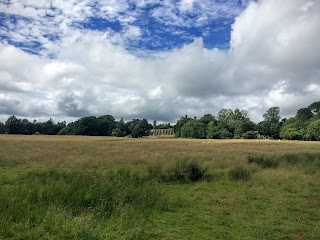 |
| More fields. The view up the hill from the Norman positions to the English. |
When you return up the hill to the remains of the abbey (like all English abbeys, the abbey was destroyed by Henry VIII), you are pretty much left on your own, and while you can explore the ruins, no additional history is provided through the audio tour. It should also be noted that most of the property at the top of the hill is off-limits, as there is today an active school where the abbey once stood.
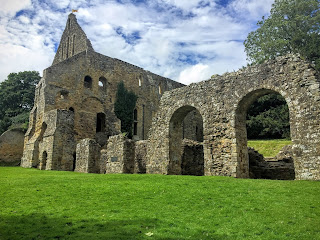 |
| The remains of Battle Abbey. |
The Battle of Hastings was no doubt of great importance, so visiting the battlefield seems like a good idea, but I am ambivalent about its suitability as a tourist attraction for families with children. I love history and therefore appreciate the site, but the visit is nothing spectacular; you are mainly walking around some fields dodging sheep dung and learning about the battle from the audio device. You would get as much by staying home and watching a documentary on the battle. The abbey was also fairly underwhelming, and there are much better specimens of ruined abbeys in England (Fountains Abbey is by far the best, but even Hailes Abbey, although almost completely destroyed, provides a better audio tour and a better education on life in a medieval monastery). I think a visit to Battle Abbey can probably be skipped by a family with limited time.


