Showing posts with label castle. Show all posts

Monday, July 4, 2016

Warwick Castle

A tourist trap.


As a commercial entity, it is neither English Heritage nor National Trust, so you will have to pay full price for your entry, plus £6 for parking (which (1) you only find out after you park there, and (2) the parking lot is a 15-to-20-minute walk from the castle). Depending on your level of entry and the age of your children, expect to pay around £100 for a family of 4.

No audio tour. This castle is not intended to educate you on the castle and its history, but rather to entertain you. Unfortunately, they come up short on the entertainment side. What you won’t learn on your visit to Warwick Castle is how it was built by William the Conqueror and was held by the powerful Earls of Warwick for several hundred years. The history is quite fascinating, so you should watch the documentary Secrets of Great British Castles on Netflix instead.

The hedge maze. Probably the worst one in the British Isles. The hedges are so low and sparse that it would be impossible to get lost in it. Not to mention that all paths converge anyway on some cheesy “educational” play areas. As with many touristy spots in June, the place is overrun with school groups, but even the kids in school were noticeably bored with the maze. Our ten year-old son was not entertained by it, though he was more diplomatic than I: “Enh, not the best.”

The dungeons. Cost an extra £9 per person, and totally not worth it. Really cheesy, not scary at all. Pretty much just caricatures of medieval stereotypes.  And, by the way, your £9 did not cover the pictures they try to sell you at the end for £20. Skip it. Your time is better spent walking back to the parking lot.

It wasn't all negative, however. Several rooms have been decorated or furnished, and the arms and armor collection is quite good.

Arms and armor display at Warwick Castle. The Tower of London's is better, though.
The best part of our visit was the longbow demonstration. England was famed for its longbowmen in the Middle Ages. A war bow could shoot up to a quarter of a mile, but the bow that was used for our demonstration was a 6'7" hunting longbow with about half the draw weight of a war bow. Still, the bowman reckoned he could shoot an arrow clear over Warwick Castle with a full draw. Due to its difficulty to master, English law required children of all classes to train on the bow at least once a week from the age of 6. This constant training was required to build up the strength to draw a full-size battle longbow and also to gain an instinct as to how the arrow will fly. The bowman never aimed his bow, he just pointed and shot. And hit. I have a video of him shooting 4 arrows in pretty quick succession at a man-sized target about 200 feet distant, and hitting all 4 in the chest.

Nock! Draw! Loose!
I also wanted to catch the trebuchet demonstration, since I have never seen a trebuchet fire in real life. However, our dungeon passes were timed for 3 o’clock, which meant we stood in line for half an hour before we were admitted to the cheesy dungeon tour around 3:30. And by the time we emerged from the dungeons, it was 4:10. We hustled down to the demo, hoping we would not have missed it — it started at 4 — but by 4:15 it was all over. I’m a bit annoyed at that.

All told, I cannot recommend Warwick Castle. Their website makes it seem like a wonderfully entertaining experience, but it wasn’t, and it was expensive. Save the money for something else. You will get a lot more out of visiting other, better castles, which I have already written about.

Saturday, July 2, 2016

Caerphilly Castle

A good excuse to go to Wales.


Caerphilly Castle is one of the largest castles in Europe, the largest castle in Wales, and the second largest in all of Britain (after Dover Castle). Being just north of Cardiff, it isn’t too difficult to get to from England. From our base in the Cotswolds, it was under 2 hours. And the neat thing about going to Wales is your kids will get to see bilingual signs everywhere. I assume it’s the law or something, but you’ll get along fine knowing only English. My cousin has lived in Cardiff for over 20 years and still can’t speak a lick of Welsh.

Built in the 13th century, Caerphilly Castle is a splendid castle known for its double moat, which was considered one of the finest castle water defenses in all of Europe. The castle was built as part of the Anglo-Norman push to subjugate the Welsh, and it saw significant action throughout those campaigns. It is generally well-preserved, though one of the towers has a pretty severe lean to it. They don't let you in that one, but they have rather amusingly put a sculpture of a man holding it up.

Caerphilly Castle is managed by Cadw, but they give discounted admission to English Heritage members. There is no audio tour, but there are numerous display signs throughout the castle to explain much of it. I still prefer audio tours, as they tend to the tell the story better, but the signs work fine. You can climb to the top of several of the towers, which is always fun for the best views.

On the grounds outside the main inner gate are displayed several medieval siege weapons, including a ballista and a trebuchet.  My son loved getting to climb up on the ballista and pretend to fire it.

And also, dragons are a thing in Wales.  A red dragon appears on the Welsh flag:


A dragon emerges from the ground outside the main gate:

The dragon billows smoke from its nostrils.
And a red dragon poses at a break in the outer wall:


All said, Caerphilly Castle is an excellent example of a medieval castle, well worth the visit if you plan to make it into south Wales. It will be a pleasant day trip if you’re based in western England, and the town of Caerphilly is also pleasant enough. You should be able to find a good pub to eat lunch in at a reasonable price.

Thursday, June 30, 2016

Bodiam Castle

“The popular ideal of a medieval castle.” — Charles Coulson
If you were asked to construct a castle, you would construct Bodiam Castle. It is the prototypical medieval castle: rectangular with round towers at the corners, moat, courtyard. Perhaps because this was just a minor castle, it did not turn into a sprawling defensive complex like many of its larger cousins. Although in ruins today, this beautiful castle is worth a visit if you're passing through East Sussex.

Built by Sir Edward Dalyngrigge in 1385 to defend the area from a French invasion during the Hundred Years War, Bodiam Castle was erected quickly and all in the same style, which accounts for its consistent design. No French invasion came during the Hundred Years War, but the castle did see action during the War of the Roses in 1483, and was slighted (as were many castles) during the English Civil War of the 17th century.  After that, it decayed into a picturesque ruin until restored in the 20th century.  In the 20th century, some defenses were erected surrounding the castle to defend the area from a feared German invasion (which, like the French invasion of 600 years earlier, never came).

Today it is worth visiting as a compact example of a medieval castle.  It is beautiful, you can climb all the way to the top, and small enough that it can be covered in its entirety within an hour or two.


Wednesday, June 29, 2016

Dover Castle


As the largest castle in England, Dover Castle is really a must-see.  But its size isn't the only thing that distinguishes it.  The history of the castle is second to none (with the possible exception of the Tower of London), having seen action from the 13th century to the 20th.  And because it has been in active use for all these centuries (and it was not destroyed during the English Civil War), it is relatively well-preserved.  Dress warmly, though, since it can get quite windy up at the top of the castle.

Few castles can boast of being able to withstand a nuclear attack, but Dover Castle was designated to be the regional seat of government in the case of a nuclear war.  For 900 years, Dover Castle has stood watch for England, repulsing waves of invaders over the centuries, from the French invasion in the 13th century to the German bombs of World War II.  Display cases at Dover Castle display weapons of war spanning its entire history, from medieval axe heads to Napoleonic cannons, to fragments of German bombs that were dropped on it.

The location of Dover Castle itself had been fortified for some 1,100 years before Henry II laid out his great castle there in the 12th century.  When you arrive, you will have to drive up some narrow, winding roads to get to the car park.  (You really should join English Heritage to get both free parking and free admission.)  From the parking lot, you are already within the Dover Castle military complex, and as you look up at one of the outer rings of defenses, you will see both Napoleonic cannons and WWII anti-aircraft guns on display.  From there, you can either climb up to the medieval castle, or down to the WWII bunkers.


The castle is large, and contains an interactive display about Henry II and the Angevin kings.  (You may not have heard of Henry II, but you have almost certainly heard of his sons, Richard the Lionheart and John I, both of "Robin Hood" fame.)  The main keep is massive, and many of the rooms have been decked out to give you some idea of what they were used for and how they looked.  There is no audio tour, so you will be able to proceed at your own pace and in whatever order suits you, but certainly make your way to the very top of the keep, where you will be rewarded with a bird's eye view of the entire area.


The underground bunkers and tunnels are less imposing to look at, but a couple of tours are offered through them to give you an idea of how they were used.  On your way down, you will pass the World War I defensive headquarters and the top of the famous double-helix staircase built during the Napoleonic era to get troops down to the beaches as quickly as possible in the case of a French invasion.  We took the shorter of two WWII tours, through the hospital tunnels.  The tour took about 20 minutes and was very good.  They simulated air raids knocking out the power, which I thought was a neat touch.  And it was a treat at the end to get to ascend back to the surface through the double-helix staircase I just mentioned.

We were staying in Kent, so Dover was just an hour away for us.  Dover is in the far southeast of England, so it's a pretty good drive from London, but certainly doable in a day trip even from there.  I do think Dover Castle is a good visit for the children because (1) it is a terrific castle as far as castles go, and (2) the history will excite any young boy of the age where he is infatuated with war (like our son, age 10).

Tuesday, June 28, 2016

Leeds Castle

Leeds Castle is a well-maintained castle that has been in continuous use since its construction in the early 1100’s. While it saw some action during The Anarchy of the 1100’s, it primarily served as a residence for the queens of England during the Plantagenet and Tudor eras, before passing into private hands, where it remained until 1974. It is today known as one of England’s most beautiful castles.

Most medieval castles fell into disrepair in the early gunpowder era. For castles that were kept up, they would have to have been in continuous use after the medieval period. We saw on our previous visit to England the Tower of London, which has been used continuously since the 11th century, and today we visited Leeds Castle, which has also been used continuously since its construction in the early 1100’s. Leeds Castle, in fact, was a private residence until 1974, so its plumbing and electricity are modern and up-to-date. As it has been well-maintained by its previous owners, it is known as one of England’s prettiest castles, more impressive by the fact of its age and history.

Leeds Castle has historically been known as a queen’s castle, having served as home to several queens and dowager queens of England, including Joan of Navarre and Catherine de Valois. It is fitting, therefore, that its last owner was also a woman, Lady Baillie. When she purchased the castle in the 1920’s, she spared no expense to repair, restore, and decorate the castle, so it is in jolly good shape. When we visited today, the banquet hall was being set up for a wedding banquet, and it looked grand indeed!

There are various parts to the grounds of Leeds Castle. After purchasing your tickets (sorry, it is neither National Trust nor English Heritage, so you will have to pay for your tickets), there is a 10-minute walk from the ticket office to the castle through some beautiful gardens. You could also take a “train” to the castle, but I do not recommend missing the walk. If you must, walk to the castle and take the train back to the start at the end of your stay.

The castle itself is built on 2 islands surrounded by a moat. The oldest part of the castle is on the far island, though there are also some ruins that originally protected the entrance on the outside of the moat. The drawbridges were replaced with permanent bridges several centuries ago, and various other parts have also been added or modified over the centuries. In the castle, there is an audio tour available in the gatehouse for £4. We are fans of audio tours when traveling with children, because it allows different members of the family to proceed at their own pace. The children always like to go a bit faster than the adults.
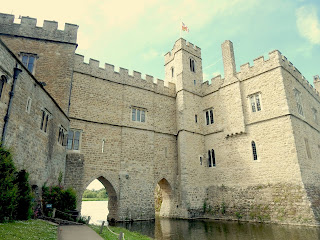

The castle tour does not take you through the entire castle complex, as much of it is still in use today, but it takes you through many of the most important living areas, which remain decorated as they were by Lady Baillie. You begin, however, in a Norman cellar, which dates all the way back to the early 1100’s. A bit of trivia I learnt ascending the steps from the cellar is that the steps were made uneven on purpose, to trip up invaders. Coincidentally, right after I mentioned this fact to my wife, she caught her foot on a step; and then I, having just watched her, did exactly the same on the same step!

Outside the castle and further on is a courtyard with a nice restaurant looking over the castle. As you walk up to the courtyard, if you turn around, you will be rewarded with some of the most majestic views of the castle and its surrounding moat.


Beyond the restaurant courtyard is a recreational area which contains a really good hedge maze. For whatever reason, children are always better at navigating the maze, so our kids made it to the middle well before we did. There is also an area where falconers put on falconry shows, which are always entertaining. Beyond that is a pavilion with a short movie about the Battle of Agincourt, and then a terrific playground for children. It’s a really good playground, and will provide parents with a well-deserved rest while their kids run around the faux-castle playground.


A note for disabled persons

Moreso than other castles, Leeds Castle does have accommodations for people in wheelchairs. While it would be impossible for wheelchairs to navigate the entire castle — as much as can be accommodated is, and there is a special movie for mobility-impaired visitors to see the parts that they are missing. Up in the recreational area, there is a good part of the playground that is designed for handicapped children, which was a very nice thought. And admission is reduced for disabled persons and their caregivers.

Sunday, July 6, 2014

Kenilworth Castle

Begun by Henry I in 1120, Kenilworth Castle became one of the most important castles in England.

Kenilworth Castle’s keep:
Kenilworth Castles keep

King John (the antagonist in the “Robin Hood” story, and the king who signed the Magna Carta) significantly strengthened the defenses and flooded the surrounding countryside to make one of the largest man-made water defenses in Europe. The castle, so strengthened, held out for six months against a siege by John’s son, Henry III, in 1266; this is believed to be the longest siege in English history.

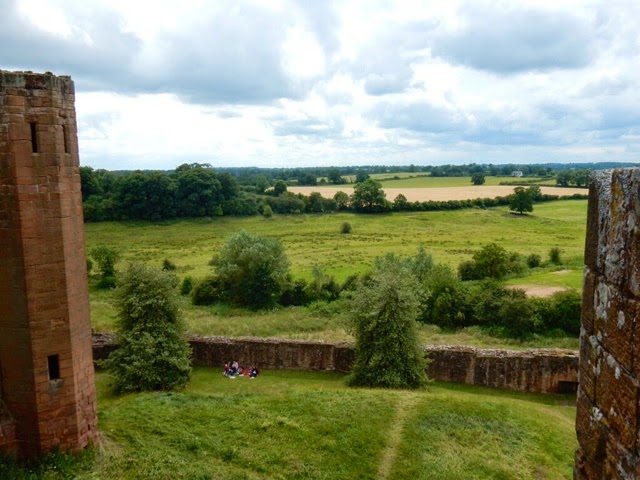
The view from one of the towers across the outer wall. The countryside beyond the wall was completely flooded into a great lake to prevent attackers from undermining the wall:
The view from one of the towers across the outer wall

  • It was here in Kenilworth Castle that Edward II was forced to abdicate in 1327.
  • It was in here in Kenilworth Castle that King Henry V received the famous “tennis balls” insult from the French King in 1414, which launched an English invasion of France and resulted in France almost completely being conquered by England. (Spoiler alert: Joan of Arc comes along and saves the day.)

In the 16th century, Robert Dudley, 1st Earl of Leicester, lavished a fortune on the castle to convert it into a palace fit for a queen, and it became one of Queen Elizabeth’s favorite places to visit. Sir Walter Scott wrote a novel about this period called Kenilworth. It appears that Leicester was hoping to marry Elizabeth. There is also a Tudor garden, originally built by Leicester for Elizabeth, if you’re into that sort of thing. I am not, and your kids might not be either, but if you are, at least your kids can explore on their own (our rule is that they can explore on their own, but they have to stay together) rather than annoying you with their boredom while you walk the gardens.

Even into the 17th century, Kenilworth Castle was formidable enough that Parliamentary forces slighted the keep to prevent it from being used as a Royalist stronghold.

This wall of the keep was pulled down by Roundheads during the English Civil War. It is notable because the cross-section shows just how thick the walls of the keep were:

While most of the castle crumbled to ruins around it, the gatehouse at least remained inhabited well into the 20th century.

We almost skipped Kenilworth, but since it was on our path from Broadway to Richmond, decided to stop in. We are glad we did. The kids spent hours wandering around and playing in the ruins. Like Hailes Abbey and Stonehenge, an audio guide is available so each member of your family can proceed around the castle at his or her own pace. It is English Heritage, so admission is free to members. There are vast lawns and picnic tables if you bring your lunch, or you can order from the café inside the walls.

I recommend Kenilworth Castle for any families visiting England. You can easily spend a few hours walking the grounds and the ruins, and it is safe enough (it is walled, after all) for your kids to explore on their own.