Showing posts with label Easby Abbey. Show all posts

Tuesday, July 22, 2014

Fountains Abbey

Fountains Abbey
Klaus with K (license)

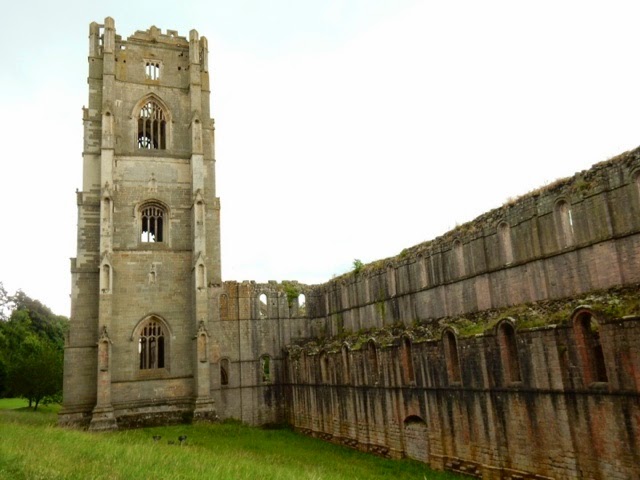
Of the three abbeys we visited — Hailes, Easby, and Fountains — Fountains Abbey was the biggest and best preserved. Fountains Abbey in its day must have been truly magnificent. The most obvious feature of the abbey is its 160-foot tall tower, which despite having been destroyed by Henry VIII, still towers over the valley. Approaching the abbey from the visitors’ center, the tower can be seen rising above the walls of the valley, and you don’t realize that you’re looking at just the very top of a tall tower until you walk the quarter mile to valley edge.

The tip of the iceberg:
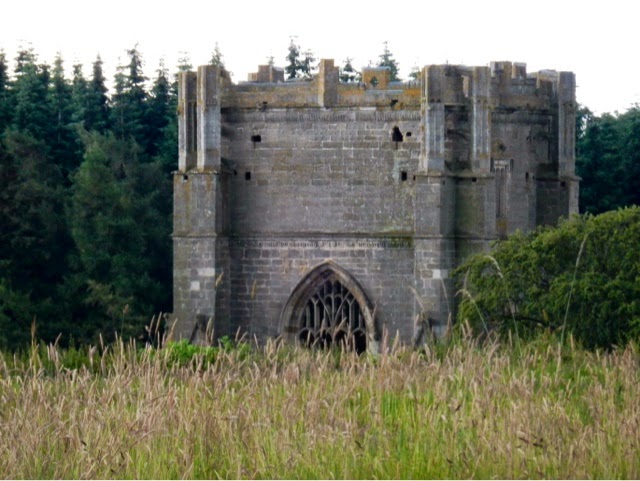
The top of the tower peaking over the walls of the valley
The rest of the tower:
The rest of the tower

But big as the tower is, the abbey itself is massive. While some of the abbey has been reduced to foundations, as was most of Hailes, there are still substantial portions standing, including most of the church:

Fountains Abbey church

Can you imagine the size of the stained glass window that went in there?

Fountains Abbey church window

But there was more — much more — to the abbey than the tower and church.

Cloister court:

Cloister court
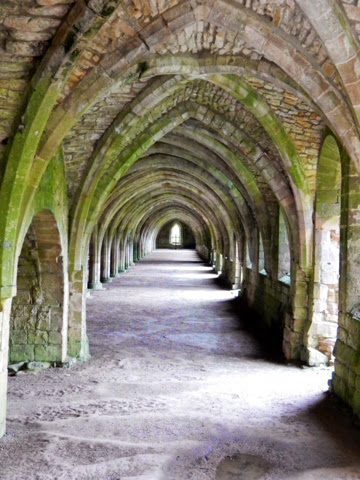
Great cloister (there is a cross way down at the far end):
Great cloister

And in addition to the remains of the great abbey, for the price of admission (free to National Trust members), you get to walk the entire grounds of Studley Royal Park, a designated World Heritage Site. Personally, I’m not big into looking at plants, so gardens don’t really excite me, so I stayed with the kids while Melinda checked out the Studley Royal Water Garden.

Studley Royal Park
Iain Gilmour (license)

Overall, Fountains Abbey was the biggest and best of all the abbeys we visited. While there is no reason to restrict yourself to visiting just one abbey, if you can only visit one, visit Fountains. We visited Hailes Abbey, in the Cotswolds, first, which is the poorest preserved of the abbeys we visited. However, we are glad we did, since its audio tour was probably the best (though Fountains was also very good). However, if we had visited Hailes Abbey after Fountains, we would have been sorely disappointed, so if you are visiting more than one abbey on your trip to Britain, visit Fountains Abbey last. We liked Fountains Abbey so much, we went back for a second visit.

Count this a definite recommendation for Fountains Abbey.

Tuesday, July 8, 2014

Richmond Castle

Richmond has been a military town since its founding in 1071, and today is home to Catterick Garrison, the largest British Army base in the world. Towering over the town is the 100-foot high keep of Richmond Castle, visible for miles around. Although the castle fell out of use in the latter part of the 14th century, it’s use as a military post was resurrected when military barracks were built within its walls in 1855, and the castle found use during World War I as a base for the Non-Combatant Corps and a prison for conscientious objectors. Today, it is a tourist site managed by English Heritage.

The distinguishing feature of Richmond Castle is its well-preserved and restored castle keep, 100 feet high with walls 11 feet thick. You can climb all the way to the top of the keep and look down over the castle walls and the River Swale on one side, and the town of Richmond on the other. Your kids will enjoy the climb and the view from the top, and will you. It is not a large castle, and you won’t be there long enough for the kids to get bored. Besides the keep, there are the remains of the chapel and several towers, which our kids thoroughly explored. You will find your kids move faster than you through ruins, but they will also make sure they explore every nook and cranny.

Apparently, there should also have been a display on the WWI prison there and the “Richmond 16,” who were imprisoned as conscientious objectors and sentenced to death (commuted to 10 years’ hard labor), but the display was closed when we were there.

Do I recommend Richmond Castle for visiting families? Yes, if you’re in the area. Middleham Castle, just 30 minutes away, is larger and more historic; if you’re pressed for time, visit Middleham instead. However, visiting Richmond Castle puts you in line of sight to Easby Abbey, so visiting Richmond allows you to knock out both of those in half a day, still giving you time to visit another site.

Easby Abbey

Easby Abbey

A church has stood at the site of St. Agatha’s church in Easby since at least the 700’s, as the remains of an Anglo-Saxon cross have been found in the church, which dates it to prior to the Viking period of the 9th century. In 1152, Easby Abbey was established around the church, and although the abbey was was dissolved in 1536 (and stripped bare by Henry’s minions), the church remains in active operation to this day.

Our apartment in Easby Hall overlooks St. Agatha’s church and the ruins of Easby Abbey. Easby Abbey is better preserved than Hailes Abbey, which we visited last week. Easby Abbey is completely unstaffed, so you just park and explore on your own. The church, too, is open for tourists, and on Sundays, you can even attend a service there. We were lucky enough to run into a local who was biking by, whom we discovered had majored in theology and happened to know an awful lot about the church and the abbey.

Surrounding St. Agatha’s church is a graveyard containing at least 2000 bodies. Some of these date back to the Anglo-Saxon period, though we would not have noticed the Anglo-Saxon markings on the stones had it not been for our guide. Inside the church is the original lead-lined baptismal dating back to the Norman period, still in use to this day. Also, in recent years, several of the frescoes, which were covered up during the Reformation, have been discovered and restored. The Anglo-Saxon cross, which was discovered in the church, resides in a museum, but the church has a replica of the cross on display.

St. Agatha’s church, surrounded by graves dating back over 1000 years:

Baptismal from Norman period and replica of remains of Anglo-Saxon cross found on-site:

Frescoes uncovered inside St. Agatha’s church:

The abbey itself is quite large. Our guide explained to us that the commissioners pulled down the roofs when they closed the monastery to prevent it from being used or reinhabited by the canons who resided there. Our kids enjoyed running around and exploring the ruins. Unlike Hailes, which had just a few walls and arches still standing, Easby Abbey had much more significant remains standing, which gave a better sense of the size and scale of the abbey.

If you’re visiting North Yorkshire and swinging by the historical sites like Middleham or Richmond Castles, you will be very close to Easby Abbey (you can see Richmond Castle from Easby Abbey, and vice versa), so it’s worth a stop and look round. Admission is free, and you can park in St. Agatha church’s parking lot. The kids will be able to run around and explore on their own, and if they look hard enough, they will discover a rather large, dark, enclosed ground-level chamber with terrific acoustics. We decided that that chamber must have been used by the monks to practice their monkish chants.